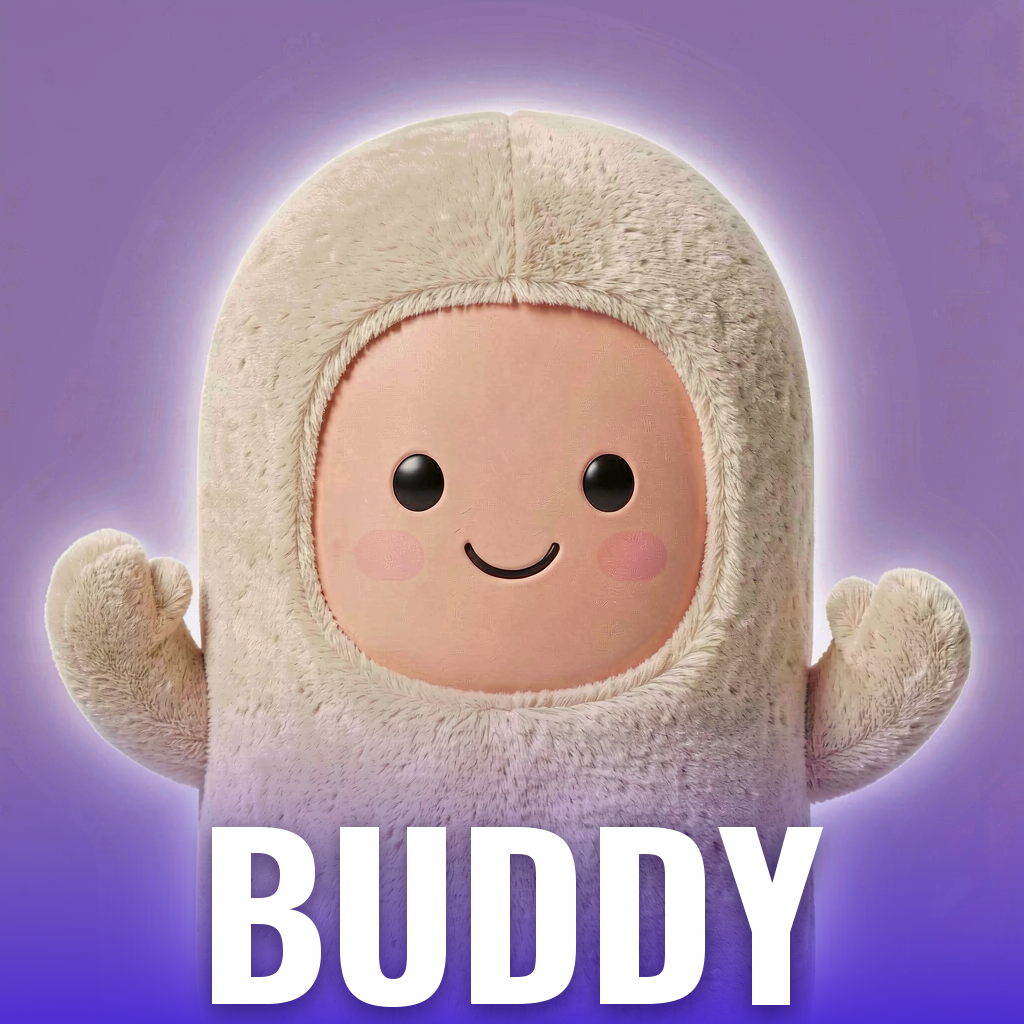
Pet care: a buddy that needs a little attention
Musse Buddy includes a virtual-pet layer. Your character has food, energy and joy, plus a bond level that rises as you care for it. You earn one treat for every finished mission. It never dies or falls ill, and the worst mood it can reach is sulky.
Coming soon to iPhone
What do the bars mean?
There are four values. Food, energy and joy run from 0 to 100 and drop slowly over time. Bond is the long-term score: it only goes up, and it sets your level. Level unlocks outfits.
Mood is shown in words on the home screen. The app has nine: feeling great, all good, a little hungry, so sleepy, bored, missed you, in love, excited and asleep.
How fast do the bars drop?
A new buddy starts with food at 80, energy at 90 and joy at 75, plus three treats. While awake, food falls about 4 points an hour and energy and joy about 3. From the starting values that means food reaches the "a little hungry" mood (below 25) after roughly 14 hours, joy reaches bored (below 30) after about 15 hours, and energy reaches so sleepy (below 20) after close to 23 hours.
So one check-in in the morning and one in the evening keeps a buddy content. Nothing needs attention every hour.
What can I do for my buddy?
Four care actions are on the Care card, each a labeled button: Pet, Feed, Play and Put to bed (Wake when it is asleep). You can also tap the character to pat it. Petting many times in a row returns less, and after five pats Buddy says it tickles.
| Action | Effect | When it says no |
|---|---|---|
| Pet | Joy up, a little bond | While asleep |
| Feed | Food up, costs one treat | No treats left, already full, asleep |
| Play | Joy up a lot, energy and food down | Too tired, too hungry, asleep |
| Put to bed | Energy comes back while asleep | Already asleep, or not tired |
| Wake | Wakes the buddy | Grumbles if energy is still low |
What do the actions give and cost?
Numbers help when you plan a session. A pat adds 6 joy. Feeding adds 30 food and 4 joy and costs one treat. Playing adds 18 joy and costs 12 energy and 5 food. Putting the buddy to bed works only when energy is 85 or lower, and feeding stops at 95 food, because a full buddy says no.
A sensible routine is short: feed when food drops below 50, play once a day while energy is above 40 and let the night sleep restore the rest.
Where do treats come from?
From finishing missions. One finished mission is one treat, and a new buddy starts with three. This ties the pet to the assistant: asking Buddy to do real things is how you feed it. The treat counter sits next to the bond level on the home screen.
See missions for what counts as a mission.
How do bond and levels add up?
Bond is the long-term score, and every care action adds some. A finished mission gives 5 bond, 8 joy and one treat. Play gives 4 bond, feeding gives 3, and a pat gives 1. After five pats in a row the pat gives no bond and only a point of joy.
Level 1 needs 40 bond. Each next level needs about a third more than the one before: 40, 54, 73, 99, then 134. Eight finished missions are enough for level 2 if you do nothing else. Higher levels open free outfits, for example sunglasses and a fire helmet at level 2, a party hat and a cowboy hat at level 3 and a medal at level 4. Treats stop piling up at 20.
Does time pass when the app is closed?
Yes, but gently. The app calculates the drop when you open it, so it works offline and costs no battery. In the current build food falls about 4 points an hour, energy 3 and joy 3, and all of them fall more slowly while the buddy sleeps.
Between 23:00 and 07:00 the buddy goes to sleep by itself, and sleeping restores energy at roughly 30 points an hour. If you wake it at night with low energy, it grumbles and loses a few joy points.
What happens if I forget about my buddy?
Nothing bad. After about two days without care and with low joy, the mood becomes missed you and the buddy asks where you were. It cannot die, get sick or lose items. The rules were written on purpose to be kind, because the product is about help, not guilt.
How is this different from a classic virtual pet?
Wikipedia describes the common pattern of virtual pets as goal-oriented care that keeps a pet alive and helps it grow (Wikipedia: Virtual pet). Musse Buddy keeps the care loop and removes the life-or-death stakes. Growth shows up as levels and outfits, and the only currency is a treat that you earn by finishing real tasks.
The trade is plain. You lose the tension of a pet that can be lost, and you gain a companion that is waiting when you come back after a long weekend. For the wider picture see virtual pet apps for iPhone.
How does the pet show up outside the app?
The home-screen widget has three care buttons, Pet, Feed and Sleep or Wake, that work without opening the app. The Lock Screen widgets show your buddy's face with its current mood. See widgets and Live Activity. For the character itself, see characters and wardrobe.
Frequently asked questions
Can my Musse Buddy die?
No. The worst state is sulky, which happens after a couple of days without care and wears off when you are back.
How do I get treats?
Finish missions. Each finished mission earns one treat, and a new buddy starts with three.
Why won't my buddy play?
It is probably asleep, too tired (energy under 15) or too hungry (food under 10). Feed it or let it rest first.
Does the buddy sleep at night?
Yes, from 23:00 to 07:00, and it recovers energy while it sleeps. You can wake it if you need it.
Is this like a classic virtual pet?
In spirit. Both ask you to feed and play with a pet. Here the treats come from real tasks, and the pet cannot die.
How long can I leave my buddy alone?
A day is fine. After about two days without care and with low joy the mood turns to missed you, and nothing worse happens.